
In the world of cheese, Swiss and Cheddar stand out for their distinctive tastes, textures, and uses. As you explore the differences between these two favorites, consider how they are produced, their origins, and their culinary applications. Swiss cheese, characterized by its iconic holes and a mild, nutty flavor, originates from the Emmental region of Switzerland. Cheddar cheese, on the other hand, hails from the English village of Cheddar and is known for its sharp, pungent flavor profile.

Understanding these cheeses involves more than just recognizing their taste. The production process, types of milk used, and aging time contribute significantly to the diverse characteristics that distinguish Swiss from Cheddar. As you navigate the cheese aisle, your selections might be influenced by these differences. Whether you’re melting cheese for a sandwich or selecting a cheese board for guests, note that Swiss cheese melts beautifully due to its higher moisture content, whereas Cheddar provides a more pronounced flavor, often preferred for cold dishes.
Your choice between Swiss and Cheddar could also be swayed by nutritional considerations. Cheeses, in general, offer valuable nutrients such as calcium and protein. Swiss cheese typically has fewer calories and less fat but is also known for its higher sodium content. Cheddar’s calorie and fat content can vary depending on whether it’s made from whole or skim milk and how long it’s been aged. Every cheese has its place in a balanced diet, and both Swiss and Cheddar can fit into your culinary repertoire with an understanding of their unique qualities.
Origins and History

When you explore the world of cheese, you’ll discover that every variety has its own unique story. Swiss and Cheddar cheeses are no exceptions, each with rich histories rooted in their places of origin.
Origin of Swiss Cheese
Swiss cheese, known for its distinctive holes or “eyes,” traditionally refers to Emmental or Emmentaler cheese. Your journey begins in Switzerland, where cheesemakers have been crafting this iconic cheese since the 13th century. Although you might encounter other varieties like Appenzeller and Gruyère, which fall under the Swiss cheese category, Emmental is the archetype known worldwide.
- Emmental: Originated in the Emme Valley of Switzerland.
- Appenzeller and Gruyère: Also hail from Switzerland, offering slightly different flavors and textures.
History of Cheddar Cheese
Moving on to Cheddar cheese, you’ll find its beginnings in the village of Cheddar in southwestern England. This cheese dates back to at least the 12th century and has become one of the most popular and widely produced cheeses around the globe.
- Cheddar: The small town of Cheddar in Somerset gave this cheese its name.
- Aging Process: Cheddar’s sharp, piquant flavor intensifies with age, distinguishing it from the milder Swiss.
By acquainting yourself with these histories, you deepen your appreciation for the cheeses’ unique qualities and the traditions that have shaped them.
Cheese Production Process
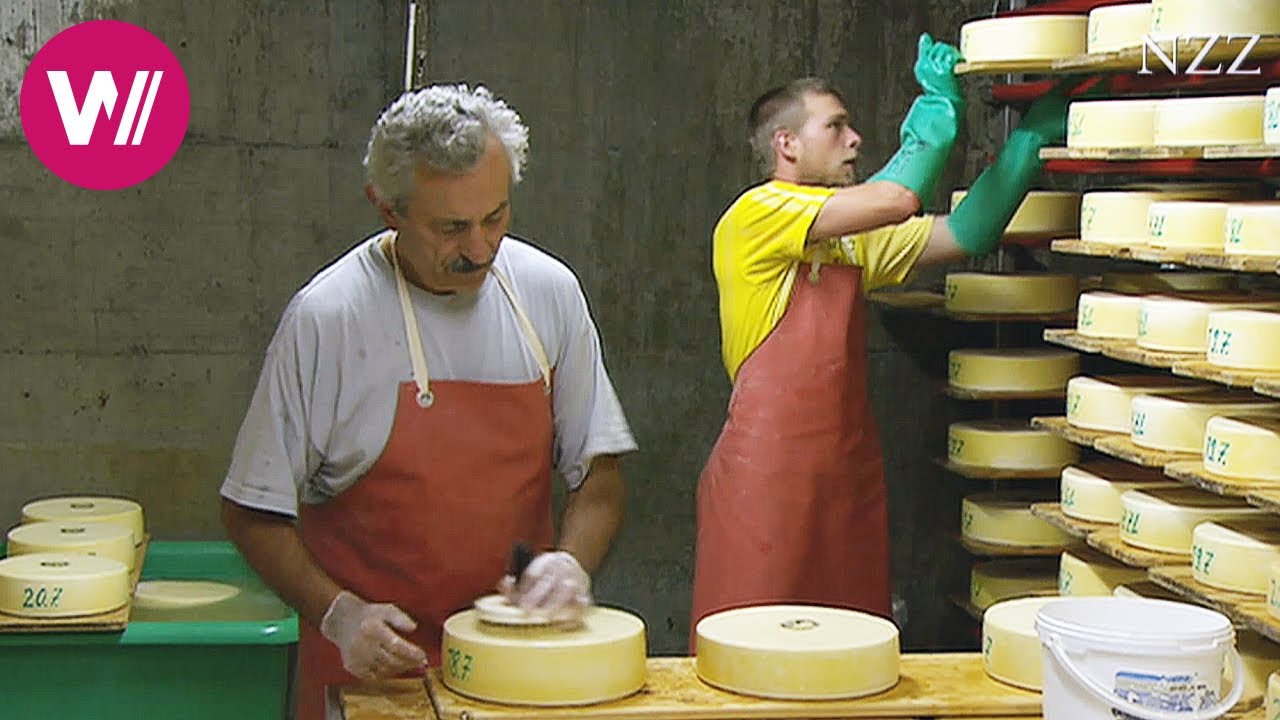
In the world of cheese, similarity ends at the basic level of milk curdling. Through intricate processes tailored to each variety, Swiss and Cheddar cheeses unfold their unique characters. Here’s an insight into the making of each.
Swiss Cheese Making
The production process of Swiss cheese, which includes varieties like Emmental, begins by warming the milk and introducing specific bacteria that contribute to the development of its mild, nutty flavor. Your next step involves adding rennet, which coagulates the milk into curds and whey. Once the curds form, they are cut to release the whey and then pressed into molds.
- Cultures & Fermentation: The bacteria used in Swiss cheese aid in producing carbon dioxide during fermentation, leading to the formation of the characteristic holes, or ‘eyes’.
- Aging: Swiss cheese is then aged at controlled temperatures, which allows its flavors to deepen and the cheese to achieve its desired firmness.
Cheddar Cheese Making
Cheddar cheese originates from the process of ‘Cheddaring’, unique to this cheese type, where the curd is cut, heated, and periodically turned as it matures, affecting its final texture and flavor profile.
- Cultures & Rennet: Cheddar starts similarly with the milk being inoculated with bacteria and the addition of rennet for curdling.
- Whey Removal & Texturing: After curd formation, you notice the whey is drained, and the curds are stacked, which helps to expel more whey and creates a denser cheese.
- Aging Process: The aging of Cheddar is what intensifies its taste, transforming it from mild to extra sharp, depending on the duration it is kept to mature.
Physical Characteristics

In discussing the physical characteristics of Swiss and Cheddar cheese, you’ll observe distinct differences in their appearance and texture that are easily identifiable.
Appearance
Swiss cheese is easily recognized by its yellow color and the presence of holes, or ‘eyes,’ which are formed by carbon dioxide bubbles released during fermentation. In contrast, Cheddar cheese typically exhibits a deep yellow or orange hue, thanks to the addition of annatto coloration, and has a solid block appearance without holes.
Texture
Your experience with these cheeses is also distinguished by their textures. Cheddar is known for its sharp and somewhat crumbly texture, which can vary from smooth in young Cheddars to dry and crumbly as the cheese ages. On the other side, Swiss cheese presents with a more smooth and semi-hard texture, making it less crumbly than Cheddar.
Flavor Profile

In exploring the world of cheese, you’ll find that Swiss and Cheddar cheese offer distinct and memorable taste experiences. Each cheese brings its unique flavor that sets it apart on any palate.
Taste of Swiss Cheese
Swiss cheese is recognized for its nutty and slightly sweet flavor. This cheese is often described as creamy, with a smooth texture that complements its taste. The holes or ‘eyes’ in Swiss cheese are not just for the iconic appearance—they play a role in developing its mild, yet distinct flavor.
- Flavor Profile: Nutty, mildly tangy, and slightly sweet
- Texture: Creamy, with varying degrees of firmness
Flavor of Cheddar Cheese
Cheddar cheese, on the other hand, is famed for its sharp and tangy flavor. As Cheddar ages, its taste transforms from mild to intensely tangy, even gaining a slightly caramelized or nutty note in well-aged varieties. A young Cheddar will present a subtler taste, but over time it develops the robustness that many cheese enthusiasts seek.
- Flavor Profile: Sharp, tangy, sometimes nutty
- Texture: Firm, becoming crumbly with age
Nutritional Value

In comparing Swiss cheese and Cheddar cheese, you’ll find differences in nutrient composition, particularly in terms of calories, fat, and essential vitamins and minerals. Both are sources of high-quality protein and calcium, but they have distinct nutritional profiles that can affect your dietary choices depending on your health goals.
Health Benefits
Swiss Cheese:
- Calcium: An excellent source, vital for bone health.
- Protein: Contains about 7.5 grams per serving, important for muscle repair and growth.
- Vitamin B12: Contains a higher amount than Cheddar, crucial for nerve function and blood formation.
- Phosphorus and Zinc: Present in higher amounts, supporting bone health and immune function.
- Sodium: Generally less than Cheddar, which might be a better choice if you’re watching your sodium intake.
Cheddar Cheese:
- Vitamin B2 (Riboflavin): Higher than in Swiss cheese, essential for energy metabolism.
- Monounsaturated Fat: Contains more, which can be beneficial for heart health when consumed in moderation.
- CLA (Conjugated Linoleic Acid): Some studies suggest that Cheddar may contain more CLA, which has been linked to potential health benefits such as improved body composition and reduced inflammation, although more research is needed.
Both types of cheese contain lactose, but generally in low amounts that may be tolerable for individuals with mild lactose sensitivity.
Comparing Calories and Fat Content
When you consider the calorie and fat content of cheeses, it’s significant to know that both types contain saturated fat and cholesterol, substances that should be consumed in limited quantities for heart health.
Swiss Cheese:
- Calories: About 110 per serving
- Total Fat: Contains less saturated fat than Cheddar, with a fat content that varies depending on the variety (reduced-fat options are available).
Cheddar Cheese:
- Calories: Slightly higher in calories compared to Swiss cheese, with calorie content depending on the sharpness and processing (lower for mild and reduced-fat versions).
- Total Fat: Generally higher in fat content, with a good proportion being saturated fat, which should be consumed carefully within a balanced diet.
Table comparing Swiss cheese and Cheddar cheese nutrition (per 1 oz serving):
| Nutrient | Swiss Cheese | Cheddar Cheese |
|---|---|---|
| Calories | 110 | Varied |
| Protein | 7.5g | Varied |
| Calcium | High | High |
| Sodium | 74mg | 176mg |
| Saturated Fat | Lower | Higher |
| Cholesterol | Present | Present |
| Vitamin B12 | Higher | Lower |
| Vitamin B2 | Lower | Higher |
Incorporating either cheese into your diet can be part of a healthy eating plan, but it’s wise to consider the overall nutritional value, including calorie and fat content, to align with your specific nutritional needs and goals.
Culinary Applications

Cheddar and Swiss cheese both offer distinct flavors and melting properties, making them suitable for various culinary uses. Your choice can significantly alter the taste and texture of your dishes.
Versatility in Cooking
When it comes to versatility in cooking, both Swiss and cheddar cheese stand out, but in different ways. Swiss cheese is known for its gooey meltability, which makes it a prime candidate for fondue and casserole dishes. This semi-hard cheese with its nutty flavor perfectly complements recipes that require a smooth, creamy consistency.
On the other hand, cheddar cheese presents a bolder and sharper taste as it ages, lending a more pronounced flavor to your cooking. Its ability to melt easily without too much stringiness makes it ideal for creating a luscious macaroni and cheese or a hearty cheese sauce.
Popular Cheese Dishes
Certain popular dishes have become go-to choices for cheese lovers due to how each cheese behaves and tastes within them:
- Grilled Cheese Sandwiches: A classic grilled cheese sandwich may feature cheddar for its full-bodied flavor, while Swiss might be preferred for a milder option with a melt that brings out a comforting softness.
- Cheeseburgers: For cheeseburgers, cheddar’s firm texture allows it to hold well under the heat, providing a tangy note to your burger, while Swiss cheese could offer a more subtle, creamy layer.
- Casseroles: Casseroles that call for a melting cheese can benefit from Swiss cheese’s ability to turn gooey without overpowering other ingredients.
- Fruit Pairings: If you’re looking to pair cheese with fruits, the mild sweetness of Swiss cheese pairs well with fruits such as apples and grapes, while the sharper cheddar can provide a pleasant contrast to sweeter fruits.
Here is a brief summary to showcase how you can use these cheeses in various dishes:
| Dish Type | Swiss Cheese Usage | Cheddar Cheese Usage |
|---|---|---|
| Sandwiches | Melted in a hot sandwich for a creamy texture | Adds a sharp, tangy flavor in cold or hot forms |
| Cheeseburgers | Provides a mild, smooth melting quality | Gives a robust flavor and holds up to grilling |
| Casseroles | Creates a gooey consistency without dominating | Offers a strong taste dimension to the dish |
| Macaroni & Cheese | Typically not the first choice due to mildness | The star ingredient for its flavorful melt |
| Fondue | The base cheese for a traditional fondue blend | Rarely used due to its strong flavor |
| Fruit Pairings | Complements with a subtle, nutty sweetness | Provides a contrasting sharpness |
Cheese Pairings
When it comes to enhancing the flavors of Swiss and Cheddar cheese, the right pairings are essential. Carefully selected companions can elevate your cheese experience.
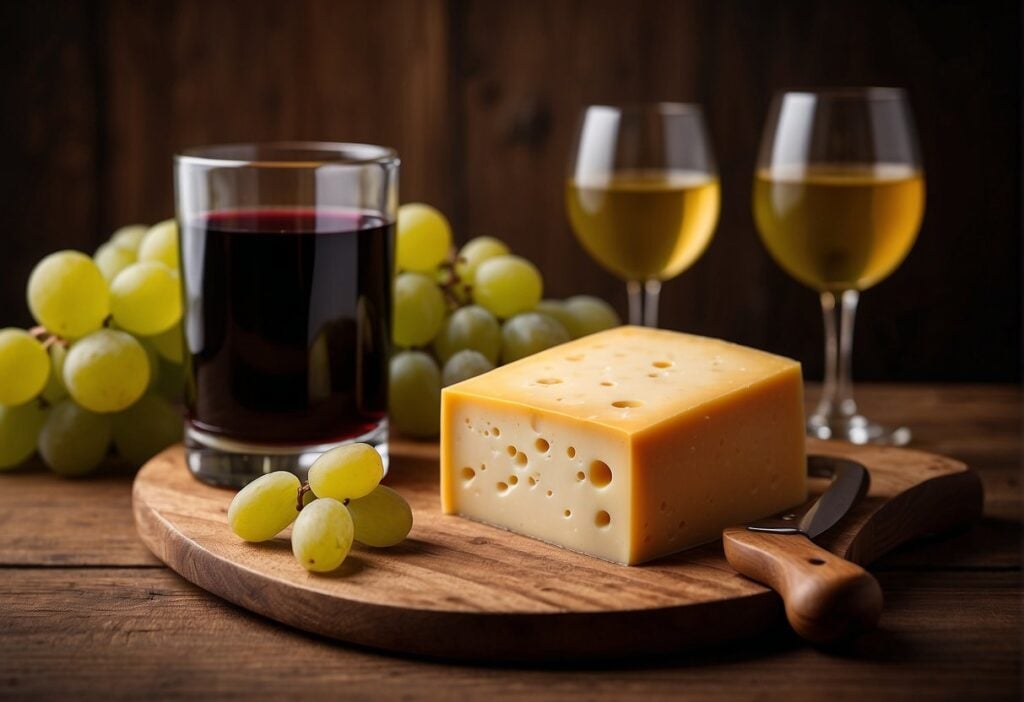
Swiss Cheese Combinations
Swiss cheese, known for its mild, nutty flavor and distinctive holes, pairs well with a variety of foods:
- Fruits: Apples, grapes, and pears complement Swiss cheese’s creamy texture.
- Breads and Crackers: Opt for crusty bread or a selection of crackers to accompany the semi-hard texture.
- Meats: Cured meats like ham or salami create a delightful balance.
- Vegetables: Roasted vegetables or mushrooms will pair nicely with its earthy notes.
When it comes to beverages, Swiss cheese goes well with:
- Wines: Light and sparkling wines, like a crisp Chardonnay or Champagne.
- Beers: Wheat beers are a great match for Swiss cheese, thanks to their light and fruity notes.
Cheddar Cheese Pairings
Cheddar cheese, with its sharp and sometimes tangy flavor, offers versatility in pairings:
- Fruits: The richness of Cheddar pairs well with tart apples and sweet grapes.
- Breads and Crackers: A robust cheese like Cheddar calls for hearty breads or crackers with substance.
- Meats: Try pairing it with smoked meats for a robust flavor combination.
For beverages that enhance Cheddar’s flavor:
- Wines: A full-bodied Cabernet Sauvignon or a fruity Zinfandel complements the strong flavors of Cheddar.
- Beers: Stouts and ales can stand up to Cheddar’s sharpness and provide a contrasting palate experience.
Consumer Considerations

When choosing between Swiss cheese and Cheddar cheese at your local grocery store, both the price and your personal taste preferences are key factors to consider.
Price Comparison
Swiss Cheese:
- Generally more expensive due to complex production processes.
- Prices can vary based on the origin and aging process.
Cheddar Cheese:
- Typically less expensive and widely available.
- Price can increase for aged varieties or specialty brands.
Price can greatly influence your decision, and it’s worth comparing at your local grocery store, as prices may fluctuate based on brand and quality.
Choosing Based on Personal Preference
- Flavor Profile:
- Swiss cheese is known for its mild, nutty, and slightly sweet flavor.
- Cheddar cheese offers a sharper, tangier taste that can vary from mild to extra sharp.
- Texture:
- Swiss cheese usually has a smoother, more elastic texture.
- Cheddar is often firmer and can range from slightly crumbly to very crumbly, especially in aged varieties.
- Usage in Recipes:
- Consider the cheese’s melting qualities and flavor contribution to your dishes.
Your personal enjoyment of the cheese’s unique characteristics ultimately drives your choice. Taste them both and select based on what satisfies your palate.
Additional Information

When exploring the realm of cheeses, your preference might lean towards either Swiss cheese or Cheddar based on their distinctive features. Recognizing the subtleties in texture, aging process, and nutritional content can enrich your understanding and appreciation for these cheeses.
- Swiss Cheese (Emmental)
- Texture: Semi-hard with a creamy texture
- Aging: Typically ages for 2-4 months, although longer-aged varieties exist
- Water Content: Higher, contributing to the formation of eyes, or holes
- Characteristics: Renowned for being a versatile cheese that melts well, making it an asset in dishes like fondue
- Cheddar Cheese
- Texture: Ranges from smooth to granular as it ages
- Aging: Generally ages from 3 months to several years, influencing sharpness
- Milk: Often made from cow’s milk, impacting its rich and mildly nutty flavor
- Appearance: Dense and sometimes crumbly, without holes
For nutritional comparisons, both cheeses are a good source of calcium and protein. Swiss cheese may have slightly less sodium than some Cheddar variations, while Cheddar can boast a higher Vitamin B2 content.
If you’re a cheese lover, these characteristics may guide you in choosing the right type for your needs. Whether you’re preparing a cheese board or cooking a gourmet meal, knowing these aspects helps you to make an informed choice. Opt for Swiss cheese when a smooth texture and even melting are desired, or choose aged Cheddar when a sharper flavor is preferred.
In the context of other cheeses like mozzarella, parmesan, blue cheese, or feta, Swiss and Cheddar hold their ground as staples with their own unique qualities that cater to different cheese lovers’ palates and culinary applications.
Frequently Asked Questions

In this section, you’ll find concise answers to some common queries regarding the differences between Swiss cheese and cheddar cheese, from their taste profiles to their nutritional content and culinary applications.
What are the taste differences between Swiss and cheddar cheese?
Swiss cheese typically has a nutty and slightly sweet flavor, whereas cheddar cheese is known for its sharper and sometimes earthy taste.
Can you compare the nutritional values of Swiss cheese and cheddar cheese?
Yes, Swiss cheese generally contains slightly less fat and fewer calories than cheddar cheese, and it can offer more calcium and vitamin B12.
How do the calorie contents differ in Swiss cheese versus cheddar cheese?
Swiss cheese contains about 107 calories per ounce, while cheddar cheese has approximately 113 calories per ounce, making Swiss cheese a lower-calorie option.
When considering health aspects, which is better, Swiss or cheddar cheese?
It depends on your dietary goals. Swiss cheese has less saturated fat and sodium, which may be beneficial for heart health, but cheddar offers higher levels of certain vitamins and minerals.
Is it possible to substitute cheddar cheese with Swiss cheese in recipes?
You can substitute cheddar with Swiss cheese in many recipes, but expect a slight difference in flavor and melting characteristics.
What are the best culinary uses for Swiss cheese?
Swiss cheese is ideal for melting in sandwiches, fondues, and baked dishes due to its smooth melting quality and complements flavors in ham and turkey well.